






Satisfactory is a first-person factory-building simulation focused on automation, resource logistics, and exponential production scaling. Unlike traditional crafting games, it emphasizes long-term system architecture, throughput efficiency, and vertical expansion.
This guide follows your progression chronologically — from your first miner placement to late-game megafactory optimization — helping you avoid structural bottlenecks and inefficient rebuild cycles.
1. First Landing: Establishing a Stable Tier 0 Foundation
Your initial hours define future scalability.
Primary objectives:
- Secure biomass power
- Automate iron production
- Unlock early hub milestones
Immediate Setup Order
Prioritize:
- Miner on pure iron node
- Smelter line
- Constructor for plates and rods
- Biomass burners
Avoid overbuilding decorative layouts early. Focus on functionality.
Early Power Discipline
Biomass is inefficient and manual. Do not over-expand before transitioning to coal power.
2. Understanding Production Ratios
Efficiency depends on matching input and output rates.
Basic Example
1 Miner (normal node, Mk1) → 60 ore/min
Smelter → 30 ore/min
Therefore:
1 Miner supports 2 Smelters.
Ignoring ratios causes:
- Idle machines
- Belt congestion
- Resource waste
Always Calculate Throughput
Before building lines, confirm:
- Input rate
- Processing rate
- Output demand
Balanced lines reduce future redesign.
3. Transitioning to Coal Power Properly
Coal power marks your first major scalability milestone.
Why Coal Matters
Coal:
- Eliminates manual biomass farming
- Provides stable power
- Enables automation growth
Optimal Coal Setup
Each coal generator requires:
- 15 coal/min
- 45 water/min
Design water extraction carefully. Poor pipe planning creates unstable grids.
4. Modular Factory Design
Avoid spaghetti layouts.
Build in Modules
Separate:
- Iron production
- Copper production
- Steel production
- Heavy modular frames
Each module:
- Independent input
- Independent output
- Clear expansion path
Leave Expansion Space
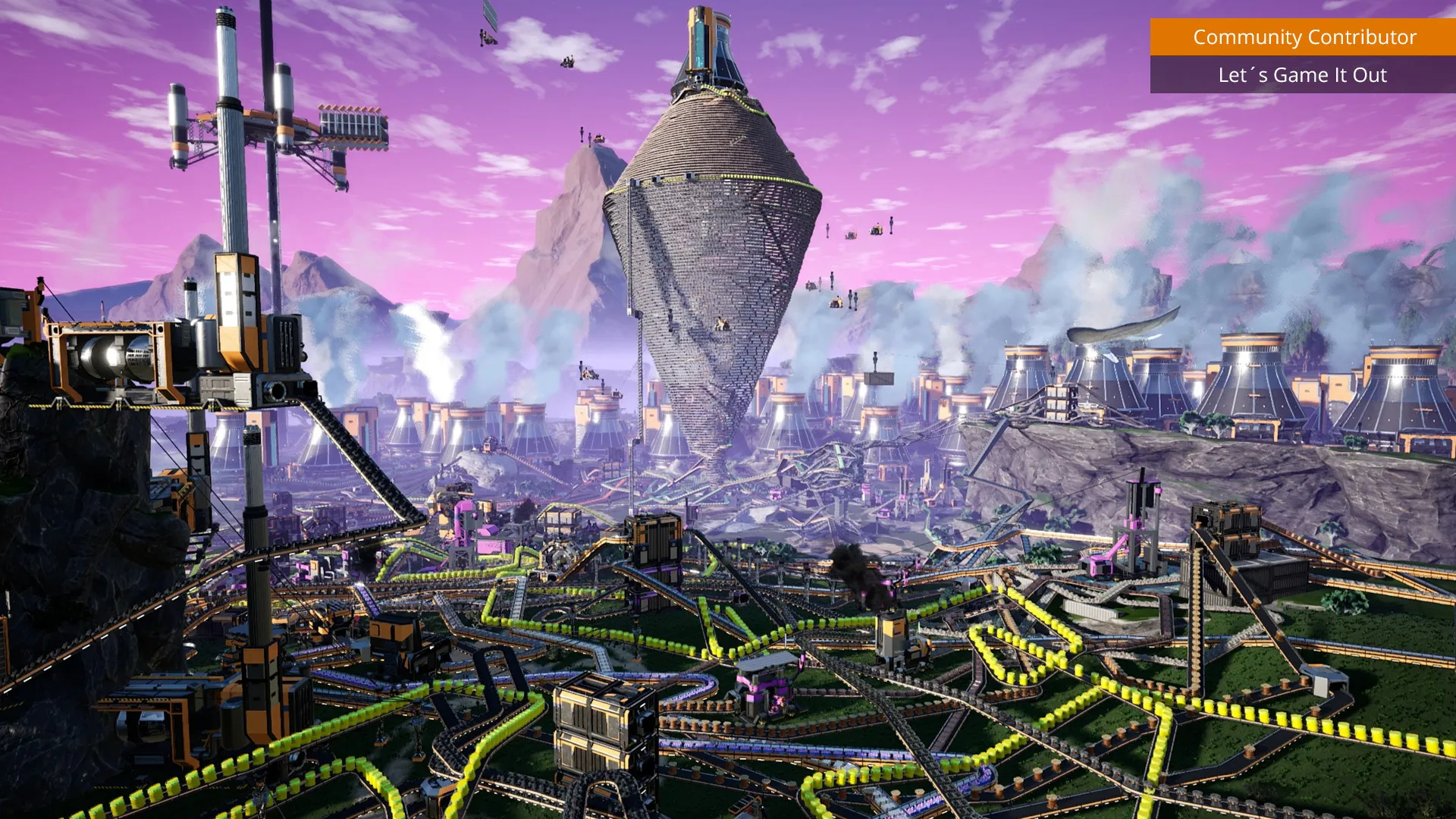
Always build with extra room. Late-game expansion requires vertical and horizontal flexibility.
5. Belt & Logistics Optimization
Logistics determine scalability.
Use Correct Belt Tiers
Do not:
- Send 270 items/min through Mk1 belts
- Mix unrelated items on same belt
Upgrade belts proactively when throughput increases.
Vertical Logistics
Use:
- Conveyor lifts
- Multi-level floors
Vertical builds reduce horizontal clutter.
6. Steel & Mid-Game Production Scaling
Steel unlocks heavy industry.
Key Products
- Steel beams
- Steel pipes
- Encased industrial beams
These are required for:
- Advanced structures
- Heavy modular frames
- Industrial expansion
Avoid Overproduction
Only produce what is needed for next milestone.
Stockpiling without demand creates power strain.
7. Oil Processing & Advanced Manufacturing
Oil introduces complex chains.
Refinery Management
Oil produces:
- Plastic
- Rubber
- Heavy oil residue
Plan for byproducts immediately. Unmanaged residue stalls production.
Use Alternate Recipes Wisely
Alternate recipes improve efficiency but require rebalancing.
Test before full integration.
8. Train & Long-Distance Logistics
As map scale increases, transportation matters.
When to Use Trains
Use trains when:
- Nodes are far apart
- Belt distances exceed practical range
- Throughput is high
Dedicated Rail Networks
Separate:
- Resource transport
- Product distribution
Cross-traffic reduces efficiency.

9. Late-Game Megafactory Planning
Late-game shifts focus to space elevator parts.
Build Dedicated Project Lines
Space elevator components:
- Require multi-stage chains
- Consume massive resources
- Demand stable power
Do not mix these lines with general factory production.
Power Grid Stability
Nuclear or fuel power becomes necessary.
Always:
- Maintain backup power margin
- Monitor consumption spikes
10. Performance Optimization & Clean Design
Large factories impact performance.
Reduce Entity Clutter
- Use manifolds instead of load balancers where practical
- Minimize unnecessary splitters
- Avoid decorative overload
Organized Cable Management
Keep power lines structured to:
- Identify faults quickly
- Avoid troubleshooting delays
Clean architecture improves long-term maintenance.
Common Beginner Mistakes
- Ignoring production ratios
- Building spaghetti factories
- Expanding before stable power
- Mixing unrelated production lines
- Underestimating logistics
Avoiding these prevents major rebuild cycles.
Conclusion
Satisfactory rewards long-term planning, mathematical precision, and modular architectural thinking. Early discipline in ratio calculation and power stability creates a strong foundation for mid- and late-game megafactories.
Approach the game as an engineering project: calculate throughput, modularize production, stabilize power, and scale gradually. With structured expansion and efficient logistics, your factory will evolve into a highly optimized industrial ecosystem.